
The next months will be packed with conversations that can move the dial. In a few short weeks we will be in New York to host Build Clean Now’s inaugural Industry Acceleration Summit: half a day, a hundred senior leaders from across finance, government and industry – and an important opportunity to learn from and replicate best practice. Through our work with developers across the world, we repeatedly see six critical levers that need to be pulled for investment to flow. Read on for more details.
With our Global Project Tracker showing that $43 billion was committed to clean industrial projects in six months – and trillions more in the pipeline – we are optimistic. There are huge opportunities to be seized for those willing to take the lead, as illustrated in our latest publication examining the steel sector in South Korea. The task now is to more rapidly close the gap between good plans and fully financed plants.
Six levers, one summit
By James Schofield, Managing Director, Industrial Transition Accelerator
As a long hot European summer finally winds down, we are looking ahead to an exceptionally busy autumn. We remain positive on the direction of travel: our latest Global Project Tracker report (released in June) showed the pace of investment into major clean industrial assets had more than doubled compared to the same period a year earlier, with some $43 billion committed in six months and a pipeline worth trillions.
Ambition is now turning into implementation – and with that, a clearer view on what levers need to be pulled by whom to more rapidly move projects from the drawing board to final investment decision and ultimately into construction and production.
So, we are looking forward to hosting Build Clean Now’s inaugural Industry Acceleration Summit in New York on Monday 21 September, together with Constructive and Boston Consulting Group. Over half a day we will gather around a hundred senior leaders, drawn from finance and industry ministries, banks and development finance institutions, industrial chief executives across the value chain, and the companies that buy what those plants make.
Getting from tens of financed clean plants a year to hundreds depends on a handful of things going right at the same time. By working with project developers across the world, we have identified those six acceleration levers: building markets for clean commodities through intelligent policy, access to renewable power, clean supply chains, buy-in from the communities that host these projects, trade flows that reward cleaner production, and genuinely catalytic capital that works to attract private finance. These are the drivers of investment decisions and will run through every conversation we have planned for the day.
We now have the evidence. Every one of those levers has real examples attached to it – a project that reached final investment decision, a policy that unlocked demand, a financing structure that made an unviable plant investable. These are the Bright Spots, and showcasing this work will lead to replication. If for example a novel Contract for Difference mechanism to unlock green ammonia projects is adopted in one country, it can rapidly be adapted then adopted in other countries.

The New York summit is organised under the umbrella of Build Clean Now, the campaign we launched with partners in 2025 to boost project investment year-on-year – and we will draw the evidence from our own work and that of our convening partners: Climate Club, Climate Investment Funds (CIF), the Energy Transitions Commission (ETC), IRENA-AFID, We Mean Business Coalition, GFANZ, WBCSD, Asia Society, UNIDO and the Blueprint Initiative.
When we set the campaign’s first target – 50 new final investment decisions in the two years before COP31 – it felt like a real stretch. While still by no means certain, we are hopeful that industry may be on track to achieve this and we will be working with partners to craft new ambitious goals beyond 2026.
Progress is predictably uneven and still fragile, and we are honest about that. But when our team leaves New York it will be with a shift in tone: from clean industry as something that is coming, to something that is already being built.
If you plan to be in New York and are interested in attending the summit, please let us know by emailing filippo.guarnieri@missionpossiblepartnership.org or piers.scholfield@missionpossiblepartnership.org
Time for Korea to seize the green steel opportunity
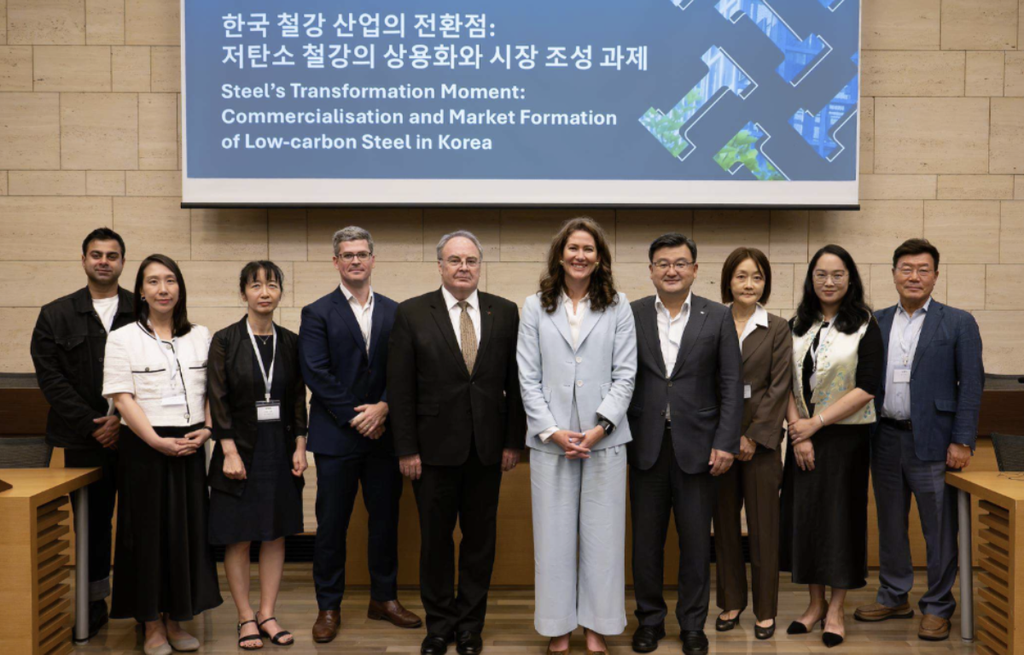
Steel is a crucial industry for South Korea. The sector employs around 1.8 million people and is one of the biggest suppliers of high-grade steel for cars, ships and electricals worldwide.
It is also one of the hardest sectors to clean up. But with carbon border taxes ramping up around the world, and China moving to hydrogen-based steelmaking, Korea’s steel sector is at a pivotal moment. The EU’s CBAM will affect around $7.7 bn of Korean exports from 2028. As other markets follow suit, traditional blast furnace steel will become increasingly costly.
But the transition to clean steel is as much an opportunity for Korea as a threat, and that opportunity is bigger than many think. While clean steel costs more to make today, our analysis shows that the output value for every plant can increase fourfold with clean production.
Clean steel creates value in three ways: it gives producers preferential access to a growing number of carbon-conditioned markets; it unlocks green premiums and it opens an opportunity for upstream technology exports. And as the global green steel market scales up, so does the opportunity for Korean technology exports, with up a prize of up to $70bn on the horizon.
Korea clearly has the capability to seize the opportunity and lead on the technology frontier, but it needs early demand to underpin the investments it needs to make. These could come from public procurement and clean steel mandates for its own carmakers, along with growing demand for clean steel around the world.
But it’s important the industry acts soon, because many traditional blast furnaces are aging and decisions will be taken on whether to invest in maintenance, which would lock in coal-based production for decades to come – or to expand new clean production.
Go deeper – to read our report: Steel’s transformation: A new engine for South Korea’s
growth and competitiveness
Coming soon: We will shortly be publishing our report on the opportunity for the Chinese and Australian steel sectors to co-operate to expand the international clean steel market.
SBTi call for insights
Do you work in Aviation, Steel or Aluminium? If so, the Science Based Targets Initiative might like to hear from you. The global corporate climate action organisation is inviting companies to share insights that will help inform the evolution of their sectoral work.
The SBTi wants to better understand the opportunities and challenges facing high-emitting sectors as they transition, helping ensure future sector resources are both science-based and practical to implement.
The aim is to gather high-quality, real-world data and evidence to enable the development of robust sector resources that reflect the operational realities facing high-emitting companies today.
If this applies to you, you can ensure your voice is heard by filling out the survey on this link before 11 September 2026.
Meet the Bright Spots: CISRI Linyi, China – forging a path for clean steel
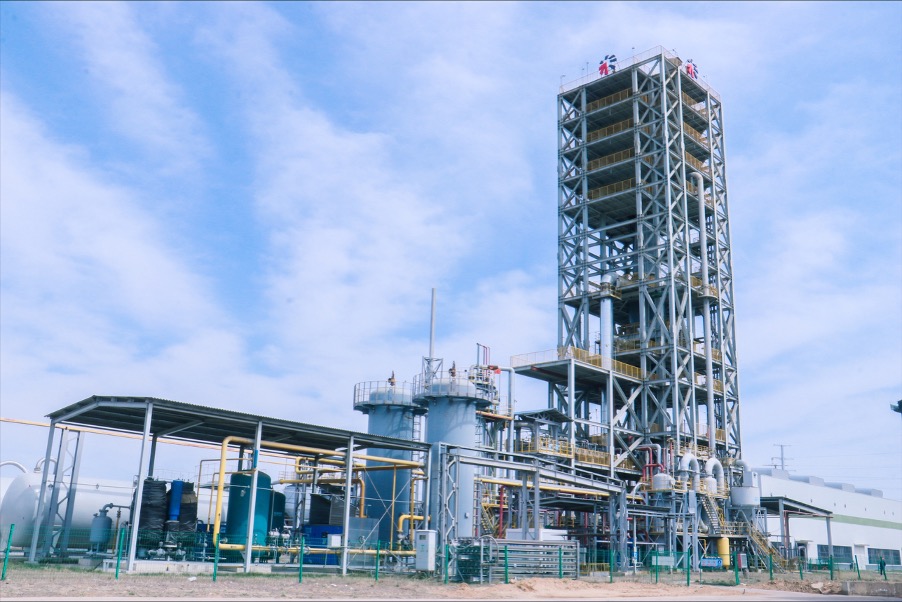
The world’s first industrial-scale direct reduced iron (DRI) plant using pure hydrogen is operational in Shandong, China. The China Iron & Steel Research Institute’s (CISRI) Linyi pilot project, with a capacity of 50,000 tonnes a year, shows how China is paving the way for a wave of commercial-scale green steel facilities through a mix of long-term research, abundant renewable energy resources and state-backed industrial innovation.
The lessons being learnt at the plant are already accelerating a wave of commercial-scale pure hydrogen DRI projects across China, positioning the country to lead the world in next generation clean steelmaking.
China makes more than half of the world’s steel and the sector is heavily reliant on coal-based Blast Furnace – Basic Oxygen Furnace (BF-BOF) production. If it wants to meet its emissions targets, it has to decarbonise steel.
CISRI is one of the pioneers of pure hydrogen metallurgy and the plant in Shandong shows that it is possible to make steel using 100% hydrogen reduction, with no gas being used. Although the plant has a 50ktpa capacity, it is being used as a validation and R&D platform, testing different ore grades and stress testing the durability of equipment in high temperature hydrogen environments, as well as refining process automation and safety systems.
Linyi has demonstrated a range of unique technical features, including:
- Electric heating of the process gas using green electricity
- Reduction 5 x faster with hydrogen than with carbon-based gases
- Virtually all iron ore grades can be processed, offering new feedstock flexibility
- ~5% higher metallisation rate than conventional DRI.
- Up to 15% lower energy consumption than with carbon-based gases.
- Recycling loop that prevents any hydrogen losses.
These findings are now feeding directly into a wave of commercial scale projects, four of which already under construction, with a further four in development.
Learn more – Bright Spot: CISRI Linyi
Go deeper – read our analysis of the latest Global Project Tracker data: Clean industry rising: the foundation of resilient value chains
UPCOMING EVENTS AND PARTNERSHIPS
As mentioned above, MPP and ITA are finalising plans for an Industry Acceleration Summit in New York on September 21st, bringing together industry, finance and policy leaders to push clean industrial projects over the line. Contact us if you’d like to play a part: filippo.guarnieri@missionpossiblepartnership.org
Watch this short video from London Climate Action Week to get a flavour of our events.
Hear more from Mission Possible Partnership at events – and access tickets on related conferences from our partners:
- Economist Enterprise: 6th annual Sustainability Week Europe (6-7 October, Amsterdam, Netherlands). Economist Enterprise’s 6th annual Sustainability Week Europe, brings together leaders to share case-studies, insights and ideas to examine the strategic decisions that will define Europe’s industrial future. Hear discussions on energy security, manufacturing, AI, finance, supply chains and clean technology as participants explore how organisations can respond to today’s pressures while positioning Europe for long-term growth. You can register your participation at this Registration link.
- Brussels Climate Week (12-16 October, Brussels, Belgium). MPP is proud to be a partner of Industry Day at Brussels Climate Week 2026. You can secure your place at this registration link.
You can find our team on the ground at the following events:
- 15th China International Steel Congress (19-20 September, Shanghai, China)
- Climate Week NYC 2026 (20-27 September, New York, United States)
- Economist Enterprise: 6th annual Sustainability Week Europe (5-6 October, Amsterdam, Netherlands)
- The Future of Green Steel 2026 (28-29 October, London, UK)
For further enquiries, please contact: filippo.guarnieri@missionpossiblepartnership.org