
Clean industry is on the rise. Momentum is building fast: pipeline velocity has doubled this year, with 19 clean industry final investment decisions (FIDs) already taken in 2026 — double the pace of last year. Countries increasingly see clean industry as a vector for energy security, competitiveness, and growth.
Steel, however, is among the most energy- and capital-intensive industries to transform, demanding a complex set of considerations. Countries are weighing how to support the sector’s transition in the face of intense global competition — and, at the same time, how to harness steel as a vector for wider transformation, helping new manufacturing categories reach scale and thrive. Done well, the steel transition positions a country with confidence in its supply security and enduring competitiveness.
This seminar brings new light to these trade-offs: where the largest new value pools if steel transforms, how to take advantage of the shifting plates of global trade being reshaped right now and how to ensure clean jobs and prosperity are safeguarded.
The Mission Possible Partnership works closely with projects moving the dial in over ten markets and leveraging local Korean expertise and stakeholder input, has assessed the market development opportunities that await Korea in its steel transformation.
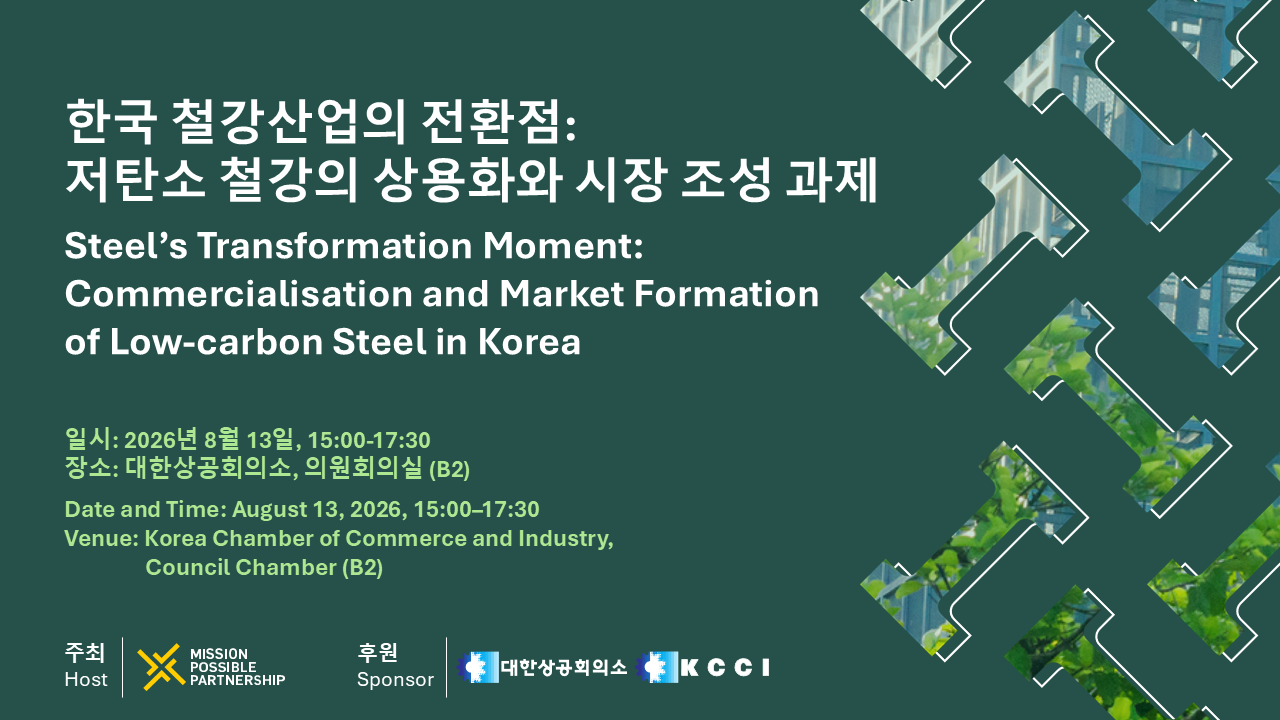
Together with the Korean Chamber of Commerce and Industry (KCCI) we invite you to join a practical dialogue among steelmakers, steel-consuming companies, industry associations, clean energy supply-chain companies, investors, and government representatives on the core enabling conditions needed to commercialise low-carbon steel production and form a low-carbon steel market in South Korea.
If you’d like to participate, please RSVP here.
Event Details
- Host: Mission Possible Partnership
- Sponsor: Korea Chamber of Commerce and Industry
- Date: Thursday August 13, 2026
- Venue: Korea Chamber of Commerce and Industry, Council Chamber (B2), 39 Sejong-daero, Jung-gu, Seoul
| Time | Content |
| 15:00-15:10 | Opening Remarks: Rachel Howard, Director of APAC, Mission Possible Partnership |
| 15:10-15:25 | Presentation 1: South Korea’s clean steel choices and value creation opportunities (Presenter: Mielle Yoo, Korea Program Lead, Mission Possible Partnership) |
| 15:25-15:40 | Presentation 2: China’s Low-Carbon Steel Transition – Integrating Supply, Demand, and Global Flows (Shuyi Li, Principal, RMI China) |
| 15:40-15:50 | Presentation 3: Dr. Sebastian Langendorf, CEO, Meranti Green Steel) |
| 15:50-16:25 | Panel Discussion 1: Upstream Enabling Conditions for Low-Carbon Steel Commercialisation Green steel transformation represents a significant opportunity for many of Korea’s existing and emerging champions – from Utility scale batteries, wind and electrolysis to complex engineering services and AI accelerated construction. This session will discuss conditions needed bring together upstream capabilities to make low-carbon steel production commercially viable in South Korea. Moderator: Cho Young-joon, Head of Sustainable Business Institute, Korea Chamber of Commerce and Industry Panelists: Eun Ko (Managing Director, NEXT Group) James Boyle (Australia Lead, Mission Possible Partnership) Manik Mahajan (Principle, Arthur D. Little – TBC) |
| 16:25-17:00 | Panel Discussion 2: Downstream Enabling Conditions for Low-Carbon Steel Market Formation A market for low carbon steel is needed to create the investment certainty for steel and upstream players. This session will discuss how South Korea can create credible demand for low-carbon steel and how producers, steel-consuming companies, and policymakers can work together to shape market formation. Moderator: Eun Ko (Managing Director, NEXT Group) Panelists: Jung-Im Nam (Head of Climate, Environment & Safety Department, Korea Iron & Steel Association Kyung Sik Kim (CEO, ESG Network) James Boyle (Australia Lead, Mission Possible Partnership) |
| 17:00-17:30 | Networking / Refreshments |
About Mission Possible Partnership
Mission Possible Partnership (MPP) is an independent non-profit advancing the decarbonisation of the world’s highest-emitting industries — aluminium, aviation, cement and concrete, chemicals, shipping, and steel. Established in 2019, MPP brings together industry, finance, and policy leaders to turn net-zero commitments into real-economy action, developing sector transition strategies and supporting the projects, policies, and market conditions needed to commercialise clean industrial production. MPP works across North America, Europe, the Middle East, India, Australia, and Asia, including dedicated work supporting South Korea’s steel sector transformation.
About Korean Chamber of Commerce and Industry
The Korea Chamber of Commerce and Industry (KCCI) is South Korea’s oldest and largest business organisation. KCCI represents more than 200,000 member companies and over 700 affiliated industry associations. It serves as the principal channel of communication between the business community and the government and National Assembly, advocating for a stronger business environment and promoting trade, investment, and international economic cooperation.