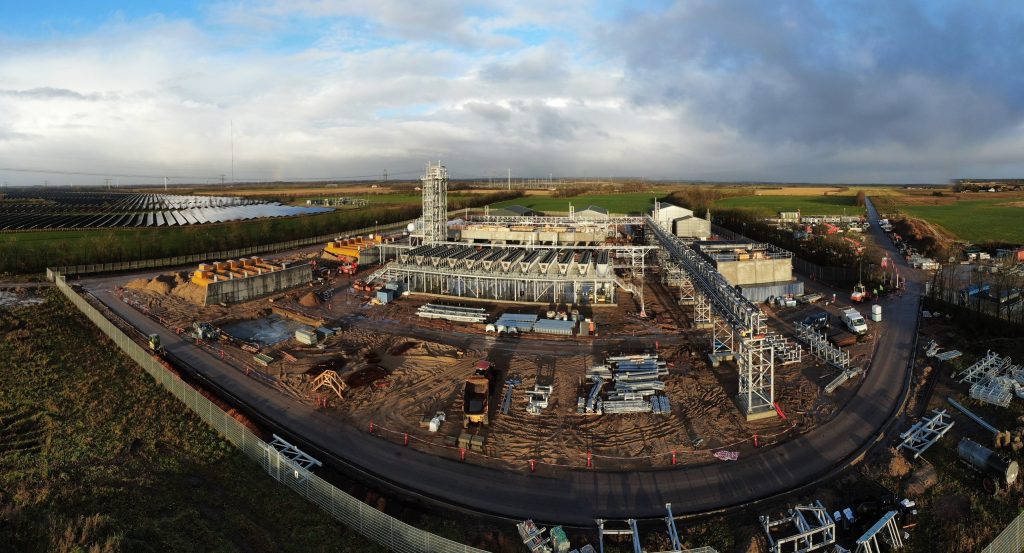
Kassø, in southern Denmark, is now home to one of the world’s first operational e-methanol facilities, producing 42,000 tonnes per year from a 304 MW solar park, a 52 MW electrolyser and biogenic CO₂ captured from a local biogas facility. It reached FID in January 2022 without operating subsidies and started operations in 2025.
European Energy is a private renewable energy developer spanning origination, construction and asset management. Recognising that direct electrification cannot reach every energy-intensive sector, it set out to convert its renewable power into low-carbon molecules, turning electrons into fuels and feedstocks for shipping, chemicals and consumer goods.
Kassø, in southern Denmark, is now home to one of the world’s first operational e-methanol facilities, producing 42,000 tonnes per year from a 304 MW solar park, a 52 MW electrolyser and biogenic CO₂ captured from a local biogas facility. It reached FID in January 2022 without operating subsidies and started operations in 2025.
Offtake as the foundation
Bankability was key to unlocking the project. In 2021, Maersk signed the anchor offtake agreement, contributing to minimize the first-mover risk and demonstrating that shipping could shift from spot contracts to long term commitments. LEGO and Novo Nordisk followed in 2023, using e-methanol to replace fossil methanol in their plastics supply chains. These three distinct markets provided revenue certainty, reducing financial risk and validating the product.
Owning the value chain
The Kassø site was built largely from scratch, with European Energy retaining control wherever possible. It supplies its own renewable power, developed its methanol synthesis technology and secured CO₂ supply from one of the biggest biogas plants in Denmark and secured the CO2 technology through the acquisition of Ammongas, a biogas upgrading and CO₂ capture specialized company. Siemens supplied electrolysers, Schneider Electric integrated the system and Mitsui & Co., which holds a 49% stake, added methanol market expertise and commercial confidence.
This integration proved decisive: For a first-of-a-kind project with multiple technologies, technical issues could be resolved across desks rather than across contracts – accelerating problem-solving and strengthening investors and offtaker confidence.
When you own the value chain, that’s very powerful, especially being a first mover. You can put the engineers together and solve a common problem. This is now being applied in the next suite of projects such as in Brazil, Spain, Australia and Denmark
European Energy
“When you own the value chain, that’s very powerful, especially being a first mover. You can put the engineers together and solve a common problem. This is now being applied in the next suite of projects such as in Brazil, Spain, Australia and Denmark” Jaime Casasus-Bribian, Head of PtX Projects (Americas, Iberia, Australia), European Energy, CEO Ammongas
Learnings
Permitting was a significant challenge with around 30 approvals needed rather than the anticipated five to seven, reflecting the plant’s novel hybrid nature. Operationally, power costs are the core challenge. Electricity accounts for more than half of production costs and managing production against volatile wholesale prices adds complexity. Grid connection delays also pushed back commissioning by a number of months. These lessons are now informing plans for a ~100 ktpa expansion at Kassø, where existing infrastructure, permits and operational data provide a material head start.
The business case for going first
“We are first movers and risk takers, but with a measured approach. Our expansion plan is three times the size of Kassø – big enough to be relevant, yet still manageable.” Jaime Casasus-Bribian, Head of PtX Projects (Americas, Iberia, Australia), European Energy, CEO Ammongas.
Kassø now serves as a blueprint being tested in Denmark, Brazil, Spain and Australia By moving early and operating at scale, European Energy has secured advantages later movers cannot buy: proven performance, real cost data and offtaker relationships.
What is e-methanol?
Produced by synthesising green hydrogen – made via electrolysis using renewable electricity – with biogenic or captured CO₂. The result is chemically identical to fossil methanol but with a much lower carbon footprint.
Because methanol is already widely used in shipping and the chemicals sector, e-methanol can act as a near-drop-in replacement – making it one of the most practical early solutions for decarbonising energy-intensive sectors.
Mission Possible Partnership | MPP
Mission Possible Partnership (MPP) is an independent non-profit organisation advancing global clean industry transformation. Since 2019, we have been working with some of the most energy-intensive industries: aluminium, aviation, cement, chemicals, shipping and steel, to cut their nearly 25% of global GHG emissions.
We mobilise business, finance, government and civil society leaders to speed up the shift to clean materials, chemicals and fuels. Having charted sectoral pathways to net-zero, we continue to forge new territory, lifting the barriers to enable a critical mass of clean industrial projects to break ground by 2030.
Mission Possible Partnership has people and partners on the ground in North America, Brazil, Europe, the Middle East, North Africa, India and Asia Pacific.
The ITA is a global multi-stakeholder platform -managed by Mission Possible Partnership – to fast-track decarbonisation across heavy-emitting industry and transport sectors. It aims to significantly grow the pipeline of commercial-scale, clean industrial projects to reduce emissions by 2030.
Build Clean Now is a global campaign bringing together governments, companies and finance to accelerate the pace at which clean industrial projects are financed and built, year-on-year. It is led by the Industrial Transition Accelerator (ITA) and Mission Possible Partnership (MPP).
ASME CATALYZE is a two-day summit that assembles the community of engineers, investors, and broader ecosystem leaders who are driving the next industrial revolution.
In this months’ Singal issue we dive into the latest insights from our Global Project Tracker in the new report ‘Clean industry: transformational trends’.
70 new projects: worth $140 billion of investment set to be shovel-ready in coming months
Strong growth in financed projects: 19 plants have secured funding so far this year with 12 based in China
New evidence: confirms clean chemicals and fuels markets are advancing
Manage Consent
To provide the best experiences, we use technologies like cookies to store and/or access device information. Consenting to these technologies will allow us to process data such as browsing behaviour or unique IDs on this site. Not consenting or withdrawing consent, may adversely affect certain features and functions.
Functional
Always active
The technical storage or access is strictly necessary for the legitimate purpose of enabling the use of a specific service explicitly requested by the subscriber or user, or for the sole purpose of carrying out the transmission of a communication over an electronic communications network.
Preferences
The technical storage or access is necessary for the legitimate purpose of storing preferences that are not requested by the subscriber or user.
Statistics
The technical storage or access that is used exclusively for statistical purposes.The technical storage or access that is used exclusively for anonymous statistical purposes. Without a subpoena, voluntary compliance on the part of your Internet Service Provider, or additional records from a third party, information stored or retrieved for this purpose alone cannot usually be used to identify you.
Marketing
The technical storage or access is required to create user profiles to send advertising, or to track the user on a website or across several websites for similar marketing purposes.