
“Clean industry is rising, because the world has changed”
By Faustine Delasalle, CEO, MPP
What has struck me over the past week is how widely this message has travelled. Our Global Project Tracker findings were covered by the Financial Times, Reuters and Semafor at a global level; by business media in India, Brazil, Germany and the Gulf; and by specialist outlets tracking climate, finance and the industrial transition.
The data and analysis were discussed at the Bonn climate talks and are being used by colleagues across the UN system, by national authorities and by financial institutions as they look to back initiatives that drive real change.
Clean industry is now being understood as a story of investment, competitiveness and national resilience. At a time when the global news agenda is dominated by volatility and crisis, the fact that 19 projects reached final investment decision in six months gives people something concrete to point to: the transition in energy-intensive industries is difficult, but it is definitively moving.
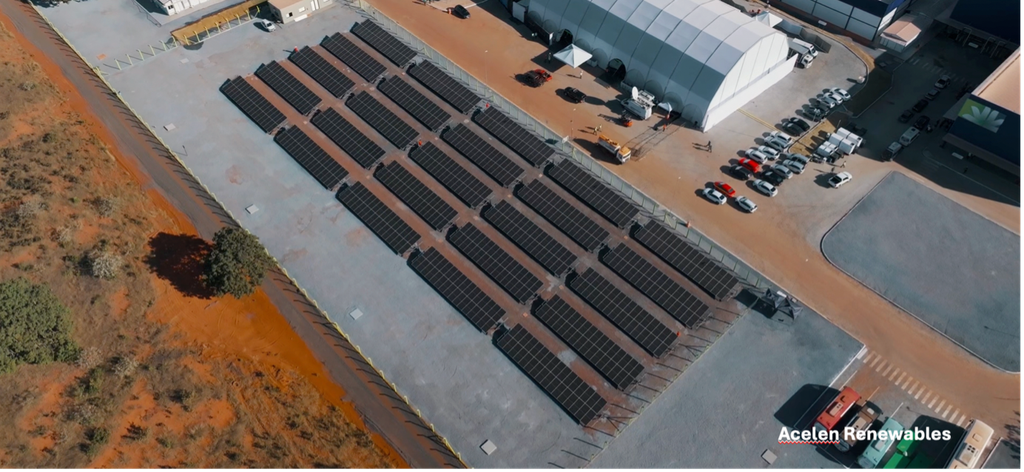
And it doesn’t stop there. In late May, just outside of our reporting window, Acelen Renewables secured investment on their biorefinery to produce sustainable aviation fuel in Brazil – a project supported by the Industrial Transition Accelerator. A sign, we hope, of more to come.
Read on for more detailed insights from the latest edition of MPP’s Global Project Tracker.
Global volatiliy reinforces the value of clean industry
For many years, the key driver for cutting emissions in energy-intensive industrial sectors was the need to cut emissions to reduce future climate impacts.
Today, those climate impacts are here, but they are just one of a basket of risks economies face, including geopolitical upheaval, trade conflicts and supply chain disruptions for energy, fertiliser and other essential products.
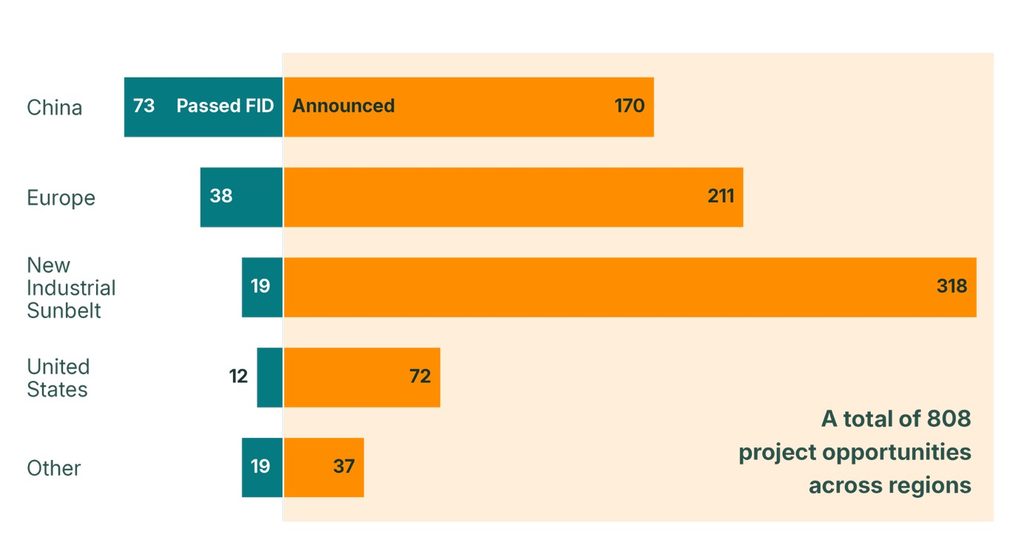
In the face of this uncertain environment, investing in clean industry looks both like a good strategic bet and increasingly good value. As a result, investment has gone from strength to strength. Mission Possible Partnership’s Global Project Tracker shows that 19 projects worth an estimated $43 billion reached final investment decision (FID) in the last six months, more than twice as many as the same period a year earlier.
China continues to scale, with 45% of all clean industry project FIDs thus far, and a fast-growing clean industry value chain.
The rise of the new industrial sunbelt
A second group of clean industry leaders is emerging across a new industrial sunbelt. These countries have renewables assets that dwarf their domestic needs and the resource base to produce clean commodities cheaply. India’s pipeline of projects grew 30% in just six months, with 65 projects announced in sectors including green ammonia, green methanol, sustainable aviation fuel (SAF) and low-carbon aluminium. Countries across the new industrial sunbelt – from Brazil and Chile to Egypt, Oman and Australia – collectively host 39% of announced projects worldwide.
ATOME’s Villeta pioneering green fertiliser plant in Paraguay is a prime example of how these projects can help reduce the country’s exposure to volatile imports, open new export markets and boost local industries. As the world becomes aware of just how much of the global fertiliser value chain is based in the Persian Gulf, the value of this new plant, in terms of food resilience and security as well as avoided emissions, becomes ever more apparent.
Explore Atome’s Villeta Project in more detail in our Bright Spots series
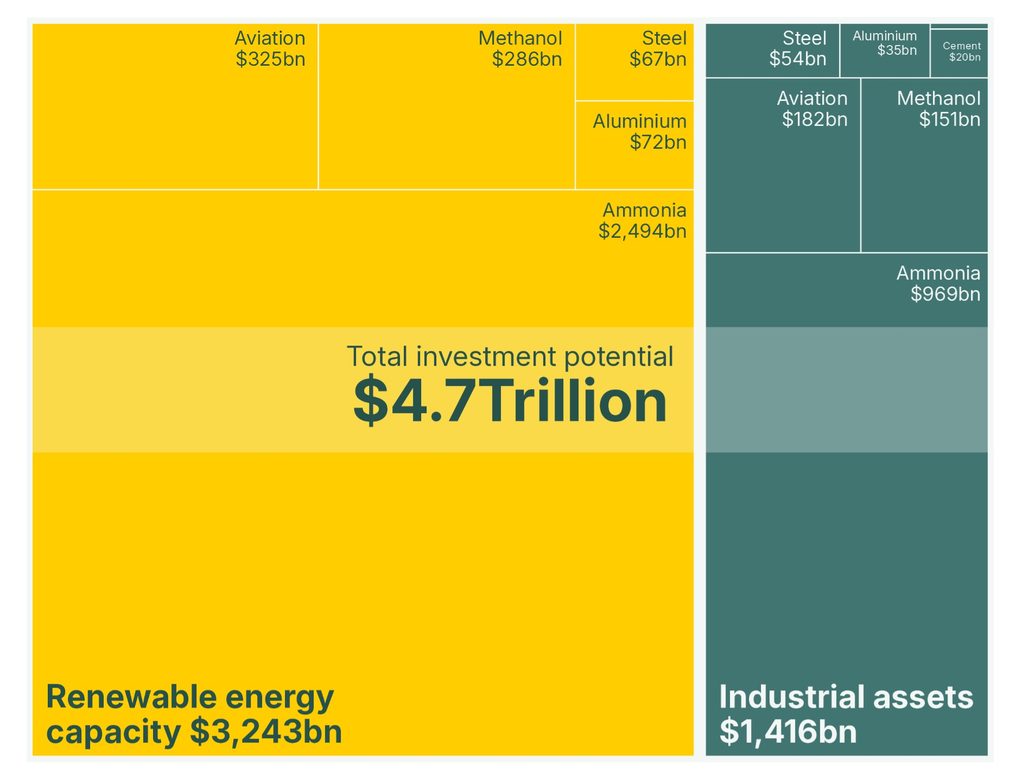
The 19 financed projects worth some $43 billion are just a precursor of things to come: an investment opportunity of around $4.7 trillion – about $1.5 trillion of direct investment in industrial plants and $3.2 trillion in associated clean energy build-out of renewables and batteries.
What is clear from all of the deals that have been signed is that markets are central to the transition. Those nations with the biggest demand for fuels, chemicals and materials – China, India, Europe and the US – sit at the top of global supply chains and have the power to shape them. Through their market and trade policies, they can decide what they produce domestically, what they import and from where.
Demand drives the market
Clean industry cannot scale without predictable demand for clean fuels, chemicals and materials – no matter how many subsidies governments put on the table.
That means offtake agreements and supportive policy regimes are essential to give investors confidence in future revenues and transform announced projects into bankable investments and viable assets. Lanzajet’s Freedom Pines Alcohol-to-Jet (AtJ) project in the US state of Georgia is benefiting from both of these, with British Airways having signed an offtake agreement for the project’s fuel, driven by its own SAF targets and mandates in markets including the EU, the UK and a number of Asian countries.
And one of the world’s first operational e-methanol facilities, in southern Denmark, was supported by offtake agreements from shipping group Maersk, toymaker Lego and pharmaceuticals group Novo Nordisk. These three distinct markets provided revenue certainty, reducing financial risk and validating the product.
A holistic approach to value chains
Investors, project developers and governments should take a holistic approach to value chains that acknowledges that different competitive advantages exist across different markets, in technology, commodity production and proximity to end markets.
Producing clean commodities such as green ammonia requires a range of integrated technologies, including renewable generation, energy storage, electrolysers, nitrogen separation and ammonia synthesis – each with numerous sub-systems that must be deployed and integrated at scale.
This creates new opportunities for energy and industrial technology developers that are not limited to a project’s host country. AM Green’s factory producing green ammonia in India is a case in point – one of its key markets will be Europe, where offtakers will be able to buy a product that will be much cheaper than if it had been produced domestically. At the same time, anchor offtakers such as Germany-based Uniper were essential to the project attracting funding, while the European technology providers including Air Liquide and Technip are providing key equipment and expertise.
It is increasingly clear that dependence on fossil fuels – not just for energy but also for materials such as steel and cement and chemicals such as fertilisers – makes nations, businesses and citizens vulnerable to higher and more volatile energy costs. Clean industrial development offers a way to reduce that dependence and vulnerability. The time to act is now.
Go deeper – read our analysis of the latest Global Project Tracker data: Clean industry rising: the foundation of resilient value chains
Industrial Transition Accelerator
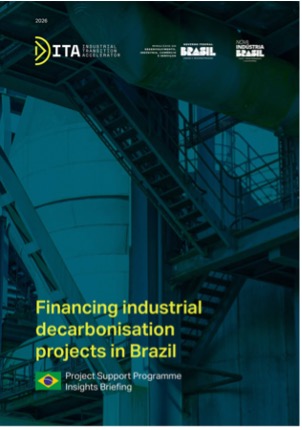
Last month the ITA published Financing Industrial Decarbonisation Projects in Brazil, an insights briefing on how to unlock investment in Brazil’s clean industry transition. The briefing looks at why clean industrial projects can struggle to meet the risk-return expectations of companies and investors.
It highlights efficiency and optimisation upgrades at existing facilities as a practical near-term opportunity, and explores ways to strengthen the investment case – including lower-cost finance, alternative models such as “sustainability-as-a-service”, and targeted action from corporates, investors and policymakers.
The briefing was timely, attracting the attention of Brazilian business and financial media, including XP Investimentos and a piece in Capital Reset drawing on an interview with our Brazil lead, Marc Farre Moutinho.
UPCOMING EVENTS – LONDON CLIMATE ACTION WEEK
MPP is hosting a series of sessions highlighting the role of industry in the global clean transition. Below are two sessions that you can apply to join:
- Building Tomorrow’s Industries Today: unlocking investment across the clean industry supply chain (24 June, 08:15-10:00)
- MPP will convene trailblazing leaders from across finance, industry and policy to examine how demand certainty, catalytic capital and cross-border partnerships can unlock investment opportunities across economies.
- The session will be chaired by Prashant Rao, Global Managing Editor at Semafor, and will welcome speakers including Olivier Mussat, CEO of Atome; Natalie Blyth, Global Head of Sustainable Finance and Transition at HSBC; Dr Yan Zhang, from the China Iron & Steel Research Institute (CISRI).
- For any questions, please contact: Piers.Scholfield@missionpossiblepartnership.org
- Decarbonising heavy industry through mass balance and book & claim systems (25 June, 14:00-17:00)
- Imperial Colleague will host MPP and RMI alongside industry, standard setting organisations, academia and civil society to discuss how innovative chain of custody systems are being explored and implemented across high emitting industries to help producers overcome the green premium for low emission products.
- For any questions, please contact Dan.Hayes@missionpossiblepartnership.org
Hear more from MPP at London Climate Action Week and access tickets on related conferences from our partners.
- Climate Innovation Forum 2026 (22 June)
- As the opening flagship event of LCAW, bringing together over 2,500 leaders from business, policy and finance, the Forum is a key platform for accelerating climate action and turning commitments into real-world impact. You can register to attend at this link.
- Building the Next Economy – at The Resilience Hub (23 June)
- As geopolitics and emerging technologies transform our world, the opportunity to build what comes next is the defining question of our time. In this session hosted by TED Countdown and Ambition Loop at the Resilience Hub, you will join entrepreneurs, investors, and innovators to share evidence of solutions underway. Turn insights about opportunities and obstacles into a vision the world can rally around and build together.
- World Climate Investment Summit (25 June)
- Catherine McFarlane, Associate Director for Europe and Programme Insights, will be at WCIS to speak on Powering the Transition: Financing Energy, Industry and Critical Systems. You can register your interest in joining the morning programme or the afternoon programme at the respective links.
- Market-making mechanisms to unlock green technologies (25 June, 11:00-12:30)
- Systemiq is hosting an invitation-only discussion for senior leaders from finance, policy, industry and civil society, exploring how innovative market-making mechanisms can unlock investment in green technologies. Drawing on cross-sectoral experience – from sustainable aviation fuel and green hydrogen to shipping and cement – the session will examine what it will take to replicate and scale approaches such as demand aggregation, advanced market commitments and double-sided auctions. Speakers include H2Global Foundation, Vioneo and ING.
- Please contact ulrike.stein@systemiq.earth for further details.
For any enquiries, please contact: filippo.guarnieri@missionpossiblepartnership.org.
Thank you for reading our newsletter.
Subscribe: sign up to Signal today