
As 2025 picks up pace, we’re starting the year by exploring ideas and partnerships for decarbonising industry that take us all the way from the Swiss Alps to new industries developing in the UAE. This month’s edition of Signal includes:
- A view from on the ground at Davos 2025 from our CEO Faustine Delasalle
- Learnings to bridge expectation gaps between US financial institutions and clean H2 project developers following our hydrogen project finance roadshow with RMI
- An update on Project SkyPower’s push to unlock investment decisions for e-SAF production by the end of 2025
- News on the latest Industrial Transition Accelerator (ITA) partnership – with the carbon recycling company LanzaTech
A view from the streets and promenades of Davos – MPP CEO, Faustine Delasalle
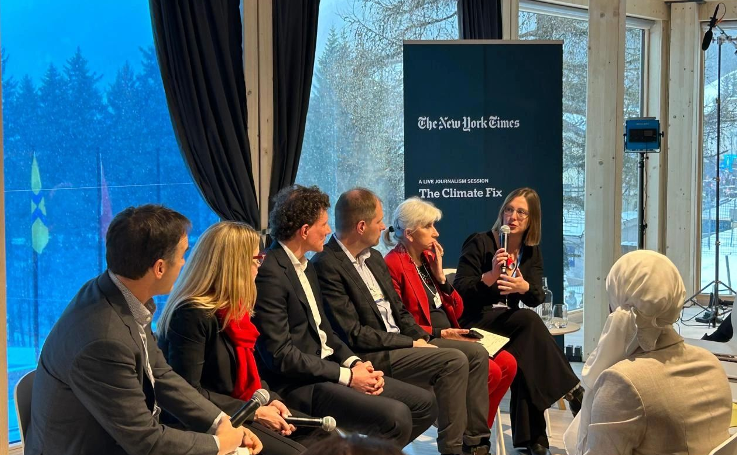
Faustine Delasalle, CEO of MPP & Executive Director of the ITA, speaking on The New York Times Climate Fix panel
If Davos is the place where the mood music of the year is written, then I’m afraid we’re in for a year of cacophony. From pounding the streets and participating in multiple panels and round table discussions, I heard three main tunes throughout my week on the (not-so-snowy) slopes of Switzerland:
- An enthusiastic opera overture: Most people in town were singing the praise of AI as the game-changing technology that will revolutionise productivity, boost economic growth, and speed up solutions for most of the world’s social and environmental problems – with its incredible thirst for energy met by a new wave of nuclear energy
- A cheerful, but imperfect ballad: There was cautious optimism in the air across the energy community: whether or not Trump likes it, we are entering the “Age of Clean Electrons”. Renewable energy and electric vehicles are cheaper than fossil fuels and are just the smart business choice. The uneasy path forward for clean hydrogen and clean industry resonated like a false note in that melody
- A terrifying requiem: The concentration of wealth, (AI) power, and (mis)information channels in the hands of a few strongmen is an existential threat for open democratic societies
Against that backdrop, I am pleased we progressed discussions on our priority themes:
- How to unlock a first wave of clean ammonia plants, leveraging opportunities across the fertiliser and shipping markets – a joint effort of leading corporates across these value chains could be the best way to push this forward
- How to further encourage and support India to take a leading role in the development of clean industry – watch this space for developments
- How to leverage COP30 in Brazil to elevate clean industrialisation on the global agenda
I look forward to getting to work on these crucial areas with old and new partners in the coming weeks.
Faustine Delasalle
CEO Mission Possible Partnership I Executive Director Industrial Transition Accelerator
Learnings from the Hydrogen Project Finance Roadshow
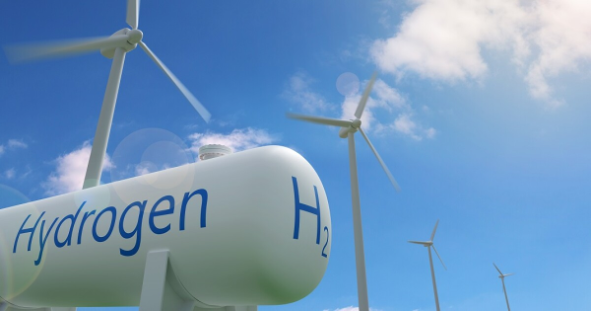
Green hydrogen is produced using energy from renewable sources like wind or solar
As part of the Mission Possible Partnership and RMI‘s Clean Industrial Hubs programme which runs in California and Texas, we undertook a knowledge exchange between 12 financial institutions and 12 hydrogen project developers. The goal was to try to bridge the information gap in the clean hydrogen market – a divide that, as in many industries, is slowing the development of this nascent sector. These insights are also relevant for other emerging climate infrastructure.
As a result, we have identified the following key expectation gaps between partners:
- Performance data: Investors lack sufficient operational data as projects often scale directly from kilowatt to gigawatt size without spending much time in intermediate steps
- Offtake expectations: Traditional project finance frameworks are too rigid, with a mismatch between buyers’ short-term and financiers’ long-term contract preferences
- Return expectations: There may be a valuation mismatch as some hydrogen developers want to be valued like technology companies, whilst investors may see them as too capex-heavy for tech-style valuations but too risky for infrastructure-style valuations
- Risk management solutions: Unlike with standard infrastructure, there is uncertainty about how to measure and price risks in emerging hydrogen infrastructure projects
- First mover investors: Despite public commitments, most financial institutions are acting as fast followers rather than first movers needed to help scale the nascent market
Building on this, we also looked to potential market developments to help close the expectation gaps, these include:
Creative deal syndicates involve spreading risk across multiple investors with complementary expertise spanning the value chain. This approach helps nascent commodity markets to mature and ensures finance reaches high-impact projects rather than just “the low-hanging fruit”.
Innovative capital stacks may combine sources such as government funding, philanthropic grants, impact investors and novel financing. This flexibility in capital structure allows for better risk sharing, bridging the gap between developers’ and financial institutions’ return expectations.
Institutional investors can increase exposure to green molecules and align their investment frameworks with industrial decarbonisation pathways. By engaging directly with industrial corporates, they can incentivise procurement reforms towards long-term green molecule offtake.
Insurance companies can play a crucial advisory role by helping sponsors during early stages to shape project configurations and commercial agreements. Early support de-risks projects and minimises future insurance costs while developing more tailored clean hydrogen products.
This is an abridged version of a paper originally written by Shravan Bhat, Carmela Chaney, Christina Pastoria and Nabil Bennouna of RMI; read the full paper here.
Project SkyPower pushes for the right conditions to unlock finance for European e-SAF

SAS – Scandinavian Airlines
2025 is forecast to be a growth year for aviation with the International Air Transport Association predicting up to 7% increase in passenger numbers and 6% in cargp. For Project SkyPower it is a critical year to unlock e-SAF, Sustainable Aviation Fuel produced from clean electricity, in Europe. SAS – Scandinavian Airlines, the national airline for Denmark, Norway and Sweden – joins the CEO-led initiative as it turns its focus to policy priorities, targeting the EU’s upcoming Clean Industrial Deal as an opportunity to support of its aim to secure final investment decisions (FIDs) for the world’s first large-scale e-SAF plants before the end of 2025.
e-SAF made from green hydrogen and CO2 using renewable electricity is needed to reduce flight emissions in addition to Bio-SAF which will likely be limited by feedstock availability.
The arrival of SAS President and CEO Anko van der Werff to Project SkyPower boosts its offtaker presence, increasing its airline representation to over 10% of European passenger aviation, and signals strong airline support for e-SAF. However, regulatory certainty and greater political support will also be essential to operationalise first-of-a-kind e-SAF projects and scale production in time to meet the 2030 European mandates which include a 1.2% sub-target from e-SAF, equating to 600kt of e-SAF or roughly 12 large-scale e-SAF plants.
As of November 2024, two-thirds of the global e-SAF project pipeline was in Europe, however, investment and offtake contracts have been stalling. The EU is also beginning to face competition from growing momentum in Asia.
The Clean Industrial Deal is scheduled to land on February 26, offering support and direction for Europe’s industrial transition. European production of e-SAF is an important emerging industrial opportunity for the continent – providing both security for the 14million aviation jobs across the continent and also openings for a global market worth up to a potential €350+bn.
With 14 CEOs from across the aviation value chain and over 50 organisations engaged in working groups, Project Skypower is pushing for a collective step-change to:
- Create regulatory certainty of e-SAF mandates and penalties
- Bridge the premium between e-SAF and fossil jet fuel with public funding via existing industry taxation while the technology scales
- Stimulate long-term demand for e-SAF at a price that addresses the economic challenges of the new fuel
- More effectively share the risk for e-SAF projects, helping to unlock private capital
For more insights on global aviation SAF projects, see our MPP Global Project Tracker here.
LanzaTech partners with the Industrial Transition Accelerator
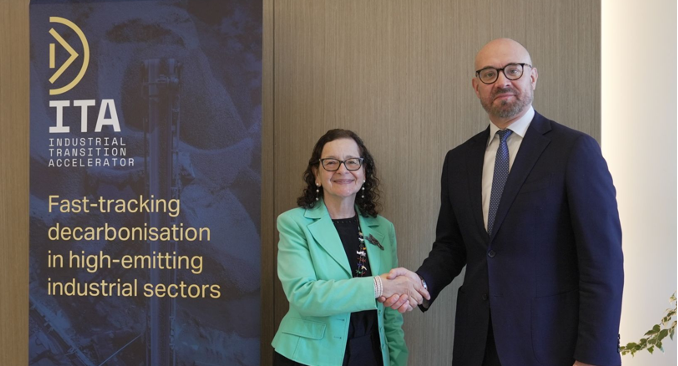
Dr Jennifer Holmgren, Chair and CEO of LanzaTech with James Schofield, Deputy Director of the ITA
The carbon recycling company LanzaTech, which transforms waste carbon into sustainable fuels, chemicals and materials, has partnered with the Industrial Transition Accelerator (ITA), an initiative hosted by the Mission Possible Partnership.
Announced at the Abu Dhabi Sustainability Week in January, the collaboration will drive innovative projects in sustainable aviation fuel and waste-to-energy, along with LanzaTech’s transformative work in steel mills and heavy chemicals.
LanzaTech and the ITA will work with regional governments, industry leaders and financial institutions in the UAE and broader Middle East and North Africa (MENA) region. They will focus on sharing their commercial expertise around emissions utilisation and lower-carbon supply chains made with recycled carbon. Learnings from this collaboration can then serve broader global decarbonisation efforts.
“As a carbon recycling company focused on hard-to-abate sectors, we are thrilled to team up with the MPP and the ITA on addressing carbon as a central feature of so many of our critical global sectors,” said Dr Jennifer Holmgren, Chair and CEO of LanzaTech.
This collaboration builds on the ITA’s existing partnership with MoIAT – the UAE’s Ministry of Industry & Advanced Technology – in a geography where industry contributes 40% to the GDP. The ITA works with local governments, industry leaders and financial institutions to strengthen the investment case for the region’s emerging clean industries and mobilise the critical capital needed to advance industrial decarbonisation. Unlocking clean tech projects can speed up the energy and industry transition for the MENA region.
FIGURES IN FOCUS
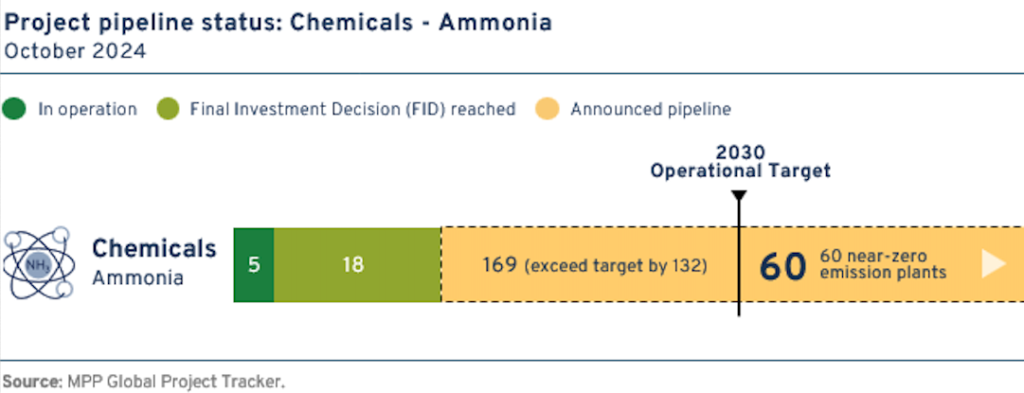
Pipeline progress for clean ammonia
Green ammonia, crucial for the production of clean fertilisers and clean shipping, is one of three sectors where the announced pipeline has exceeded the total required projects to meet 2030 goals – if all 192 projects reach FID it will be >300% of its target of 60 operational near-zero plants. Check out our Global Project Tracker for more project information.
UPCOMING EVENTS AND PARTNERSHIPS
Hear more from MPP at events and access tickets on related conferences from our partners.
- EGYPES Egypt Energy Show (17-19 February, Egypt International Exhibition Centre, Cairo, Egypt)
- Join ITA Deputy Director, James Schofield, at the event by registering at this link.
- International Energy Week (25-27 February, QEII Centre, London, UK)
- Join ITA Deputy Director, James Schofield, at the event by registering at this link.
- Innovation Zero World Congress (29-30 April, Olympia London, UK)
- Registrations are now open for the World Congress, where MPP is an official Forum Partner. Register here to join us.
- Innovation Zero America Congress (17-18 June, Palm Events Centre, Austin TX, USA)
- Save the date to attend the America Congress, where MPP is an official Industrial Forum Partner. Registration opening soon.
- FT Live Hydrogen Summit 2025 (24 June, Marriott Grosvenor Square, London, UK)
- Join MPP CEO, Faustine Delasalle, at the Summit by registering at this link.
Thank you for reading, if you enjoyed this newsletter, please share it with your network.
If this edition of Signal was shared with you, you can sign up for our monthly mailings here.
The Mission Possible Partnership Team