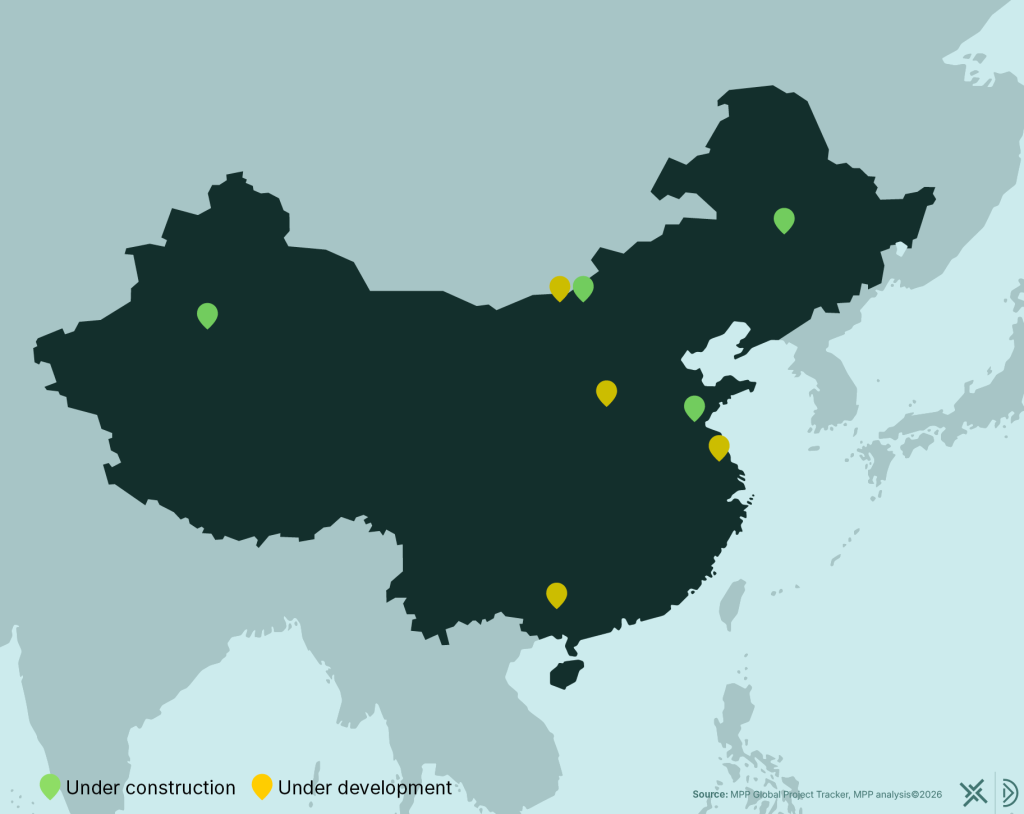
CISRI’s Linyi project in Shandong Province represents one of the most significant breakthroughs in global iron and steel decarbonisation. As an industrial-scale pure hydrogen direct reduced iron (DRI) facility, the project demonstrates China’s ambition to advance to near-zero carbon metallurgy by combining long-term research, abundant renewable energy resources and state-backed industrial innovation.
Read the full case study on our Build Clean Now campaign website
Bright Spot | CISRI Linyi
The China Iron & Steel Research Institute Group (CISRI) is a national research institute and state-owned enterprise in China, overseen by the central State-owned Assets Supervision and Administration Commission (SASAC). It has been conducting research on pure hydrogen metallurgy for more than 20 years. CISRI’s Linyi project in Shandong Province represents one of the most significant breakthroughs in global iron and steel decarbonisation. As an industrial-scale pure hydrogen direct reduced iron (DRI) facility, the project demonstrates China’s ambition to advance to near-zero carbon metallurgy by combining long-term research, abundant renewable energy resources and state-backed industrial innovation.
As the second most industrialised province in China, the pure hydrogen DRI demonstration plant was strategically commissioned in Linyi, Shandong. It provides an ideal location to showcase its technology to downstream users, regulators and future investors.
The Linyi plant is fully optimised for 100% hydrogen reduction with no syngas or natural gas blending possible. The pilot tests have demonstrated some unique technical features including electric heating of the process gas using clean electricity, the ability to process virtually all iron ore grades, achieving a ~5% higher metallisation rate than conventional DRI and a design that incorporates a recycling loop that prevents any hydrogen losses. The facility operations are also 100% automated and incorporate advanced AI-assisted safety controls, heating optimisation and support digital twin development.
Although the Linyi facility has a nominal capacity of 50 ktpa, it is not used commercially. Instead, it functions as an R&D and validation platform. Test results are now feeding directly into a wave of commercial scale projects, four of which already under construction:
One 300 ktpa plant in Songyuan (wind-powered).One 300 ktpa plant in Songyuan (wind-powered)
Two lines of 600 ktpa each in Baotou, Inner Mongolia
Two plants in Xinjiang, one of 300 ktpa and one of 1,200 Mtpa
With four more under development, all using 100% green hydrogen.
Delivering the Linyi project required deep collaboration across China’s industrial system:
National and local state grid authorities to guarantee renewable electricity supply.
Hydrogen producers to ensure consistent hydrogen availability.
EPC subsidiaries of CISRI to deliver engineering, construction and commissioning.
Downstream steel users to secure product offtake, especially with high-end manufacturers.
Local & national governments for permitting, policy support and renewable energy access.
Because China’s steel sector faces overcapacity, offtakers are generally reluctant to coinvest. However, for high-end steel grades enabled by pure hydrogen metallurgy, CISRI is engaging select customers. Carbon-free DRI produced via hydrogen metallurgy offers additional intrinsic advantages, particularly for the manufacture of higher-end and special products such as automotive steel, tool and die steels, superalloys, stainless steel and electromagnetic materials.
Pure hydrogen metallurgy is becoming cost competitive in China, due to the very low-cost of clean electricity, which has reached average costs as low as 0.1 RMB/kWh (i.e. ~15 $/MWh). Other driving factors include increasing scale in renewable hydrogen, in-house engineering and fabrication capacities and strong policy alignment with national decarbonisation targets.
The Linyi project represents a turning point for both China’s and the world’s steel industry. CISRI is demonstrating that pure hydrogen metallurgy can be technically viable, cost competitive under China’s renewable energy conditions and scalable with more than 4 Mtpa of capacity already under development.
The Linyi project represents a turning point for both China’s and the world’s steel industry. CISRI is demonstrating that pure hydrogen metallurgy can be technically viable, cost competitive under China’s renewable energy conditions and scalable with more than 4 Mtpa of capacity already under development. By combining abundant renewables, state backed innovation, strong engineering, procurement and construction capabilities and a fast-growing domestic technology base, China is gearing up to position itself as the centre of near zero carbon iron-making.
Mission Possible Partnership | MPP
Mission Possible Partnership (MPP) is an independent non-profit organisation advancing global clean industry transformation. Since 2019, we have been working with some of the most energy-intensive industries: aluminium, aviation, cement, chemicals, shipping and steel, to cut their nearly 25% of global GHG emissions.
We mobilise business, finance, government and civil society leaders to speed up the shift to clean materials, chemicals and fuels. Having charted sectoral pathways to net-zero, we continue to forge new territory, lifting the barriers to enable a critical mass of clean industrial projects to break ground by 2030.
Mission Possible Partnership has people and partners on the ground in North America, Brazil, Europe, the Middle East, North Africa, India and Asia Pacific.
The ITA is a global multi-stakeholder platform -managed by Mission Possible Partnership – to fast-track decarbonisation across heavy-emitting industry and transport sectors. It aims to significantly grow the pipeline of commercial-scale, clean industrial projects to reduce emissions by 2030.
Build Clean Now is a global campaign bringing together governments, companies and finance to accelerate the pace at which clean industrial projects are financed and built, year-on-year. It is led by the Industrial Transition Accelerator (ITA) and Mission Possible Partnership (MPP).
This senior-level, market-facing forum brings together key stakeholders from across the value chain to examine how the transition is progressing in practice.
In this month’s issue of Signal, we dive into the new EU Clean Industrial Deal, we look into policies for decarbonising the cement industry, and we give a run-down on low-emission chemicals in Brazil.
Mission Possible Partnership and the Korea Chamber of Commerce and Industry are hosting a dialogue on the core enabling conditions needed to commercialise low-carbon steel production in Korea.
Manage Consent
To provide the best experiences, we use technologies like cookies to store and/or access device information. Consenting to these technologies will allow us to process data such as browsing behaviour or unique IDs on this site. Not consenting or withdrawing consent, may adversely affect certain features and functions.
Functional
Always active
The technical storage or access is strictly necessary for the legitimate purpose of enabling the use of a specific service explicitly requested by the subscriber or user, or for the sole purpose of carrying out the transmission of a communication over an electronic communications network.
Preferences
The technical storage or access is necessary for the legitimate purpose of storing preferences that are not requested by the subscriber or user.
Statistics
The technical storage or access that is used exclusively for statistical purposes.The technical storage or access that is used exclusively for anonymous statistical purposes. Without a subpoena, voluntary compliance on the part of your Internet Service Provider, or additional records from a third party, information stored or retrieved for this purpose alone cannot usually be used to identify you.
Marketing
The technical storage or access is required to create user profiles to send advertising, or to track the user on a website or across several websites for similar marketing purposes.