To:
Mr Stéphane Séjourné, Executive Vice-President for Prosperity and Industrial Strategy, Ambassador Aingeal O’Donoghue, Permanent Representative of Ireland to the European Union, Christophe Grudler MEP, Pierre Jouvet MEP, Anna Cavazzini MEP
14 September 2026
Six priorities for lead markets in the Industrial Accelerator Act
Dear Co-legislators,
We, the undersigned businesses and organisations, welcome the proposal for the Industrial Accelerator Act (IAA) as a necessary starting point for building lead markets for clean industrial products made in Europe. Europe has a substantial pipeline of deep decarbonisation projects across the aluminium, cement, chemicals and steel sectors – an estimated €85bn investment opportunity – but many still lack the demand certainty needed to reach Final Investment Decision (FID) and ultimately produce near zero emissions and low-carbon commodities. Strong, predictable lead market measures can reduce revenue risk and give investors confidence in future offtake. We are committed to doing our part: investing in future capacity and bringing competitive low-carbon products to market. The IAA does not operate in isolation: the EU ETS, CBAM, Energy Performance of Buildings Directive, Public Procurement Act, and CO2 Performance Standards will progressively close the cost gap between low-carbon and conventional production. Yet this transition will take time, and lead market measures are needed now to create the certainty carbon pricing alone cannot yet provide. Robust measures should enable projects to reach FID faster, while maintaining industry’s commercial viability and competitiveness of downstream users.
To unlock the IAA’s transformative potential, we encourage co-legislators to strengthen the proposal:
1 Add demand side incentives for near-zero emissions materials
A single broad definition of “low-carbon” will not give near-zero emissions production projects the certainty they need, especially in sectors where existing production pathways1 already meet low carbon thresholds. Co-legislators should therefore establish a staircase of performance classes, with the top class calibrated against the best available technology expected in 2029 and onwards2. Lead market requirements should recognise these differences in performance: increasingly stringent requirements over time, sub-targets for near-zero classes, or multipliers that weight near-zero emissions materials more heavily3. Such a graduated system would reward deeper emissions reductions and reflect the added costs first movers face, giving the IAA a broad low-carbon materials market, while ensuring the highest-performing projects retain a distinct, durable market of their own, with multipliers and sub-targets adjusted over time as these materials become more widely available.
2 Move fast to establish definitions
Definitions for low-carbon commodities and products are required swiftly. Definitions for steel should be finalised by early 2027, as per the Ecodesign for Sustainable Products Regulation (ESPR). Definitions for cement and concrete, under the Construction Products Regulation, and for aluminium, under the ESPR, should be finalised as soon as possible and in any case well before the IAA’s obligations take effect in 2029, giving capital-intensive industries the lead time their investment cycles require, and downstream industries time to adapt their supply chains.
Definitions should be based primarily on emissions performance, technology neutrality, and account for sector-specific criteria (e.g., concrete strength, recycled steel content):
• For steel, a sliding scale based on recycled content should be used, to encourage the uptake of low emission iron while rewarding circularity.
• For aluminium, low-carbon definitions should be based on a robust carbon accounting methodology that reflects the physical carbon footprint of the metal across the value chain, including the emissions embedded in pre-consumer aluminium scrap and using location-based Scope 2 emissions factors.
• Harmonised definitions should be set for cement and concrete, which ensure a consistent approach between the two products, incentivising low-carbon clinker, cement with reduced clinker content and incorporation of SCMs and low carbon fillers at the concrete production step.
Compliance should rely on harmonised, independently verified environmental data including Environmental Product Declarations (EPDs), for credible, comparable assessments across Member States.
3 Set the market signals high enough to trigger new investments
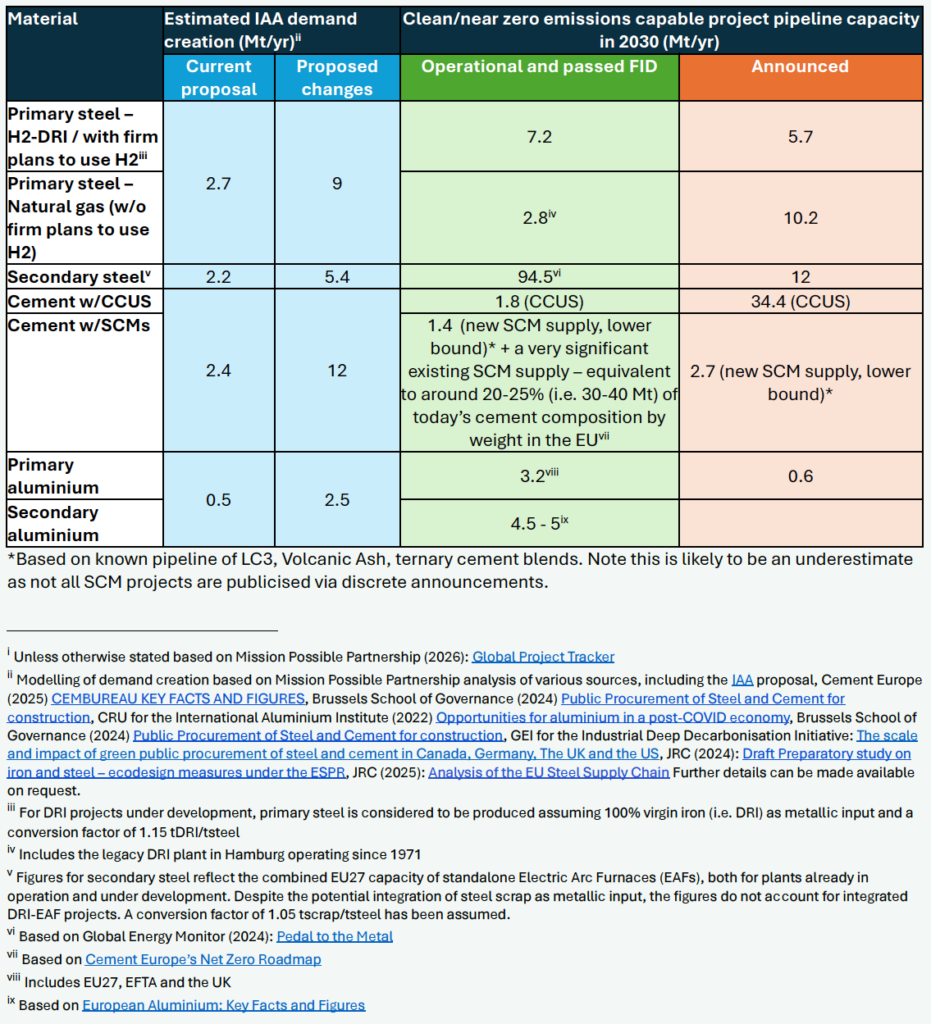
The IAA proposal sets low-carbon requirements at 25% for steel and aluminium and 5% for concrete/mortar, within Public Support Schemes (PSSs) and Public Procurement. This results in a demand signal much below the production capacity already at FID/available.
Adjusting the scope, thresholds and timelines would give producers the signals needed to unlock new FIDs and bring the pipeline of low-carbon production online:
• Raise % requirements by 2029 to at least 50% for aluminium, 50% for steel, and 25% for concrete/mortar and cement in line with actual committed capacity and market availability.
• Provide visibility beyond 2030 to unlock new investments. Given lead times from FID to operations, 2029 demand will benefit projects already past FID. Investors need certainty that demand will keep rising before they commit capital for new projects. The Commission should explicitly commit to develop successive targets in three-year increments that ramp up over time and are set 4-5 years ahead to allow for FID to operations lead times. • Increase the share of public support schemes within the scope of the IAA. In the Commission proposal, 45% of public support schemes budgets are subject to requirements; this should be extended to 100%, with the benefit of reducing complexity.
• Expand measures in select sectors such as automotive beyond PSSs, accounting for differences between vehicle categories and value chains – for instance technical constraints, market competitiveness and cost impact.
The IAA’s reliance on PSSs is a structural risk: if schemes are scaled back, the demand signal weakens with them. To guard against this, the IAA should enable Member States to sustain/expand PSS funding, for example, through leveraging a dedicated share of Member State ETS 1 revenues or greater state aid flexibility.
4 Clarify “Made in Europe” (MiE) rules to protect strategic industries without sacrificing flexibility
MiE rules offer a chance to secure a European foothold in low-carbon capacity, improve supply chain resilience, and protect strategic industrial production. However, they should strike the right balance with affordable clean imports of energy-intensive materials and fuels that benefit the competitiveness of downstream industries and reduce prices for consumers.
This balance could be struck as follows:
• For steel, MiE rules should build on the established melted and poured rule to retain high-value steps like steelmaking, rolling, coating and finishing while allowing competitive imports of energy intensive inputs (e.g., Direct Reduced Iron or Hot-briquetted Iron) from diversified trusted partners, and safeguarding a critical mass of European capacity.
• For aluminium, MiE rules could require smelt-and-cast operations to take place within the EU ETS1 and linked systems.
• For cement and concrete, MiE rules could focus on clinker produced within the EU ETS1 and linked systems – as downstream products are less traded than in metals, the competitiveness impact is more limited.
5 Extend demand-side measures to include chemicals and fertilisers
Chemicals and fertilisers are strategic sectors for Europe’s competitiveness, resilience and decarbonisation ambitions. As the Critical Chemicals Alliance discussions recognise, demand-side measures should support not only basic materials, but the industrial ecosystems that enable downstream sectors to transition. Like steel, aluminium and cement, low-carbon and circular chemicals and fertilisers face a significant first-mover challenge: major investments need clearer demand signals and revenue certainty.
We therefore recommend extending the IAA’s scope, or setting a clear pathway under it, to develop demand-side measures for these sectors, including fertilisers. The IAA gives the Commission power to develop measures only for chemicals containing carbon, however fertilisers should be included in full. As a first step, the Commission should adopt a roadmap for demand-side measures for low-carbon and circular chemicals and fertilisers within 12 months of the IAA’s entry into force, building on the Fertilisers and Chemicals Industry Action Plans, establishing a clear timeline towards demand targets or minimum requirements for low-carbon fertilisers.
6 Ensure coherence with other EU legislative files, notably the newly released Public Procurement Act
Predictability depends not only on the IAA’s demand creation measures, but on other legal instruments not inadvertently undermining them. The Public Procurement Act (proposed in September 2026) should explicitly confirm that contracting authorities can and should embed sustainability and low-carbon requirements in tenders. Ambiguity in procurement law would otherwise create loopholes that undercut those measures and reintroduce exactly the market uncertainty the IAA seeks to remove. Procurement rules should reward whole-life carbon performance, lifecycle cost, innovation and longterm value rather than defaulting to lowest upfront cost – so that the most effective solution is selected for each project.
We stand ready to support the co-legislators in refining these measures and would welcome the opportunity to discuss them further. Europe’s window to lead in a clean industrial future is closing fast.
Yours sincerely,
Supporting organisations
FertigHy
Heidelberg Materials
Holcim
Hydnum Steel
Norsk Hydr
Polestar
Ramboll
Stegra
SSAB
Tata Steel Nederland
Titan Group
Demand Creation Coalition
Convening organisations
Mission Possible Partnership
E3G
Steel Zero Climate Group
Note that endorsement of this statement does not mean that endorsers agree with all details relating to sectors in which they are not directly involved, nor with the specific sources and modelling details in the annex.
|